
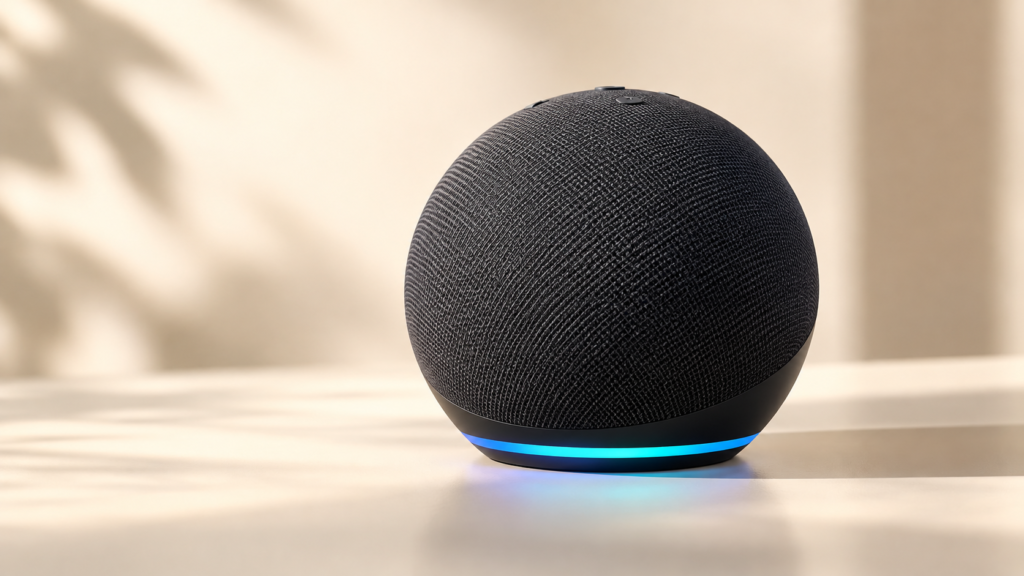
Amazon has introduced five new Echo devices designed to make its Alexa assistant more useful across everyday home activities. The lineup, announced on October 28, 2026, combines updated speakers and displays with a smart clock and a photo frame, reflecting Amazon’s effort to bring more AI-powered interactions into the home.
The announcement is more than a hardware refresh. Several devices are designed around contextual assistance, where Alexa can respond to what is happening around the user rather than simply answer a spoken question.
What has Amazon announced?
Amazon’s official product announcement introduces five devices:
- Echo Dot: A new smart speaker with an integrated smart-home hub, an eero Wi-Fi extender and an AI accelerator for on-device processing.
- Echo Studio with Home Camera: A speaker with a camera that adds visual context to certain Alexa interactions and supports checking in on a room through the Alexa app.
- Echo Time: A camera-free bedside clock with a customizable display and sleep-sensing features designed to adjust the timing of its alarm.
- Alexa Photo Frame: A 10-inch touchscreen frame that connects to Amazon Photos and uses Alexa to help users find and display pictures.
- Echo Show 16: A redesigned 16-inch smart display with Fire TV built in, customizable home screens and an updated smart-home dashboard.
The devices vary in how they use AI. The new Echo Dot includes hardware for on-device processing, while the camera-equipped speaker uses visual information to support certain tasks. The Echo Show 16 focuses on combining home organisation, entertainment and smart-home control in one display.
What is changing about Alexa?
Amazon is positioning Alexa as more than a voice interface for weather updates, timers and music. The company says the latest version can handle more complex requests, ask clarifying questions and coordinate information across different sources.
On supported displays, a new Cards interface organises conversations so users can return to previous interactions through Echo devices, the Alexa app and Alexa.com.
The launch also includes Alexa Home Map, an interactive visual representation of compatible smart-home devices. It is intended to help users see where devices are located and control them through a more spatial interface.
The Verge’s coverage of Amazon’s October hardware event describes how the company is pairing the new devices with updated software and deeper conversational capabilities. The publication also reports that Amazon has shifted towards a series of smaller product launches rather than relying on one large annual hardware event.
Why does this matter?
The launch shows how consumer technology companies are trying to make AI a regular part of household routines. Rather than requiring people to open a chatbot or app, a home assistant can be available through a speaker, display or other connected device.
That approach could be useful for managing schedules, controlling compatible appliances, finding photos, planning meals or interacting with entertainment systems. It also creates more opportunities for AI to operate with information about the user’s surroundings and preferences.
But convenience comes with trade-offs. Devices with cameras, microphones and environmental sensors can collect information about household activity. Consumers should understand what each device senses, what data is processed locally or remotely, and which privacy controls are available before enabling features.
What should buyers consider?
The new devices are not interchangeable, and the most feature-rich product will not necessarily be the best choice for every home.
- Check compatibility. Confirm that existing lights, locks, thermostats and other devices work with the relevant Echo features.
- Consider camera placement. The Echo Studio with Home Camera has different privacy implications from a camera-free speaker or clock.
- Review sleep-sensing claims carefully. Echo Time’s sleep features are product capabilities described by Amazon, not a substitute for clinical sleep assessment.
- Check subscriptions and regional availability. Some features require Alexa+, and the announcement’s US prices do not establish availability or pricing in every country.
- Compare the actual use case. A speaker, photo frame and large smart display serve different needs, so buyers should weigh the features they will genuinely use against the cost.
Pricing and availability
Amazon’s US announcement lists the new Echo Dot at $99.99, the Echo Studio with Home Camera at $249.99 and Echo Time at $199.99. The Echo Show 16 is available for preorder from $499.99, with its launch scheduled for December 16, according to The Verge’s product availability report.
Most of the other announced devices are available in the US, but availability varies by product. Amazon’s announcement does not establish worldwide launch dates or pricing for every market, so international buyers should check their local Amazon store before making plans to purchase.
What remains uncertain?
The launch announcement describes Amazon’s intended features, but it does not independently establish how well the devices will perform across different homes or how much value users will gain from the new AI functions.
The usefulness of visual assistance, sleep sensing and smart-home mapping will depend on device placement, compatibility, software updates and user preferences. Privacy-conscious buyers should also review the relevant settings and data-handling information for each device rather than assume all Echo products process information in the same way.
The takeaway
Amazon’s latest Echo lineup shows the company expanding Alexa across more household contexts, from bedside routines to photo browsing and smart-home control. The combination of new hardware and conversational AI could make the assistant more useful for everyday tasks.
For buyers, the decision should come down to practical value, compatibility, privacy and cost, not the number of AI features advertised. The broader question for the smart-home market is whether these additions make connected devices genuinely easier to use while giving households sufficient control over their information.